AI-Augmented Content Design
A framework for deciding where AI can contribute — and where human judgement should lead.
The invisible work
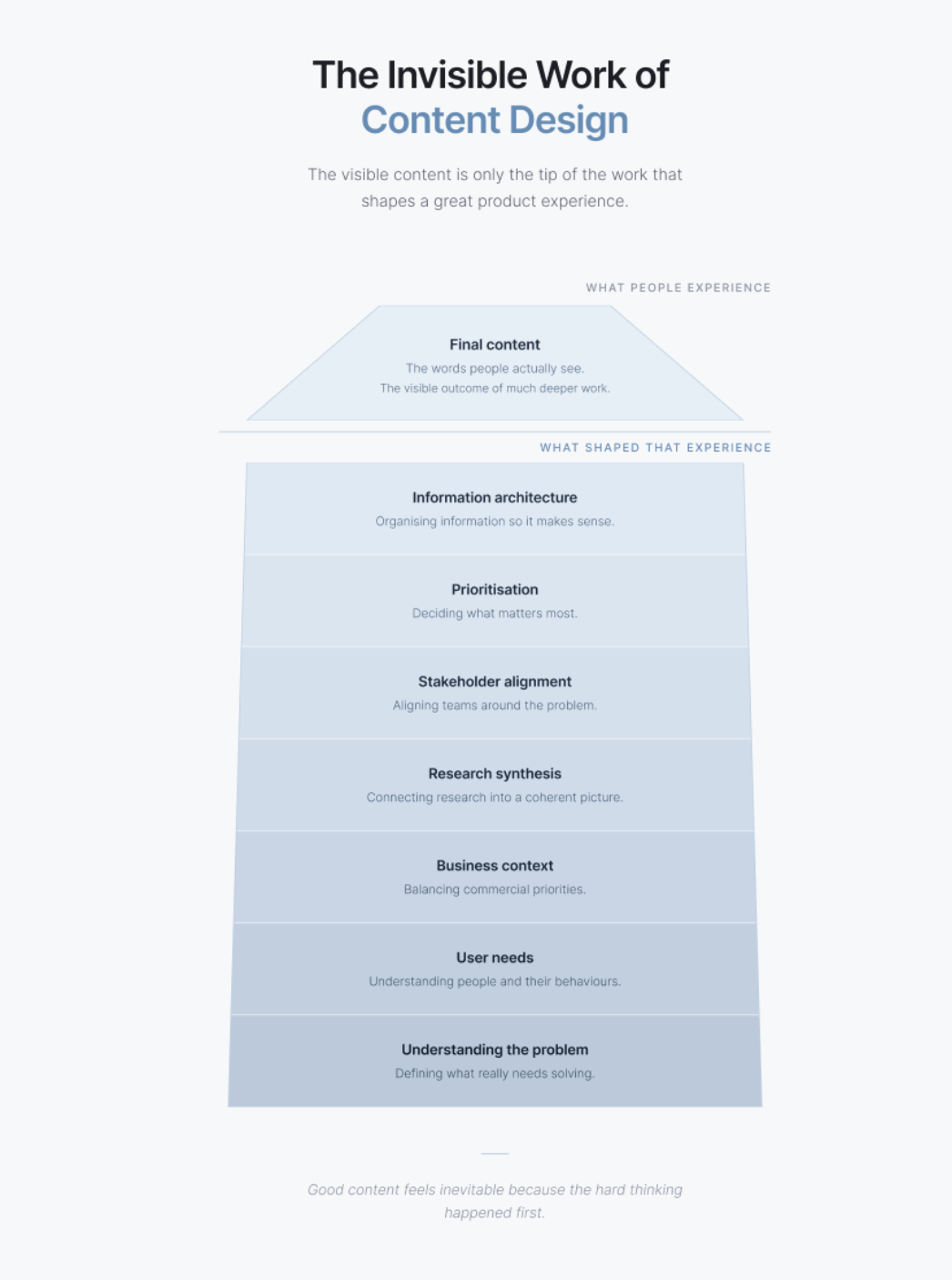
People often assume content design is primarily about writing. In my experience, writing is one of the final stages of the process.
Long before a headline is written or a button label appears in Figma, content designers are already shaping the outcome.
We're understanding the problem. Synthesising research. Balancing user needs with business goals. Aligning stakeholders. Making trade-offs. Designing information architecture.
Deciding what matters - and what doesn't.
By the time we write the words, most of the important decisions have already been made. And that’s why good content often feels inevitable because of all the hard thinking that happened first.
I think the best way to visualise this is with a simple iceberg.

So where does AI fit in all this?
If the final written content is only the visible part of Content Design, then asking whether AI can write misses much of the point.
The more useful question is what role AI should play in all the work that happens before the words appear.
Where can AI genuinely contribute — and where does human judgement still need to lead?
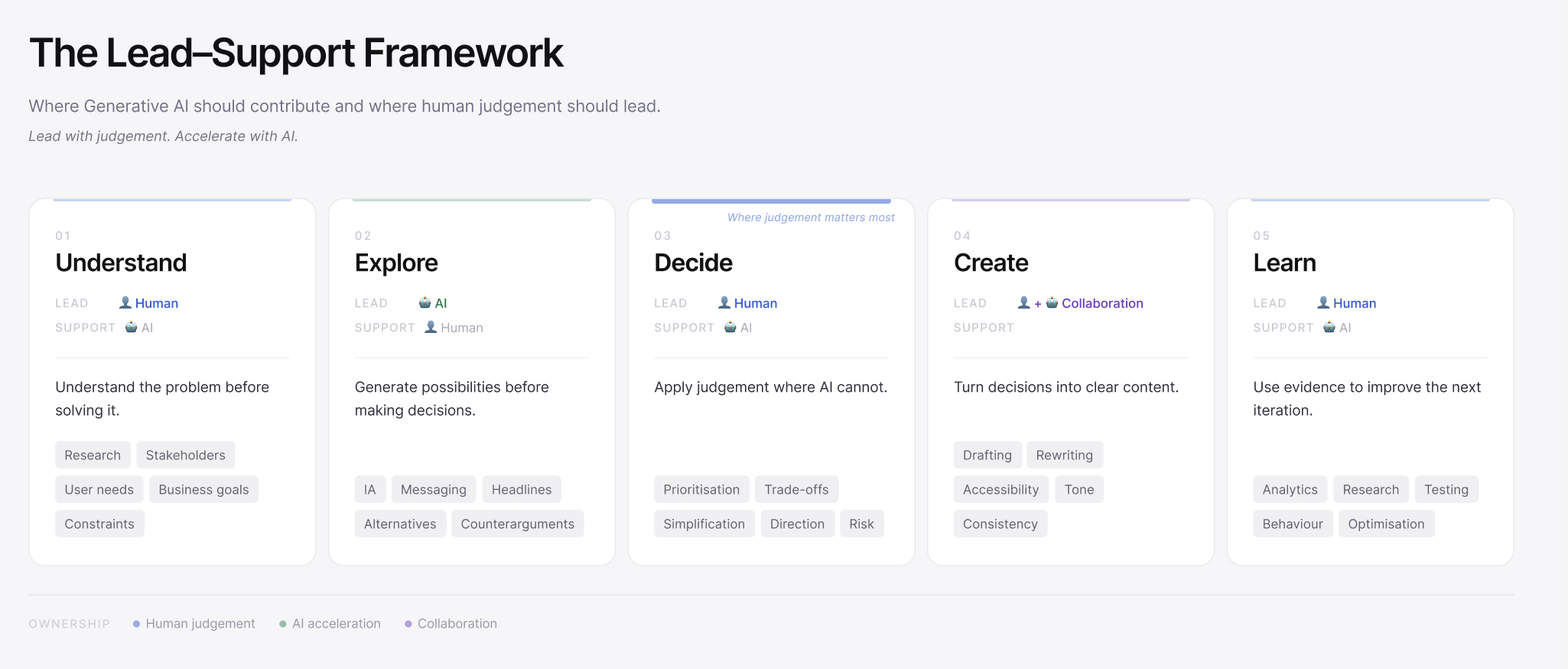
The Lead–Support Framework
Rather than asking whether AI can replace content designers, I've found it more useful to ask
a different question.
At each stage of the content design process, who should lead—and who should support?
Through using Generative AI in my own work, I've gradually developed a simple framework.
It helps me decide where to lean on GenAI, where to use it as a thinking partner,
and where human judgement should remain firmly in control.
This framework isn't a process to follow. It's a way of thinking about responsibility.
At each stage of content design, what role should Generative AI play?
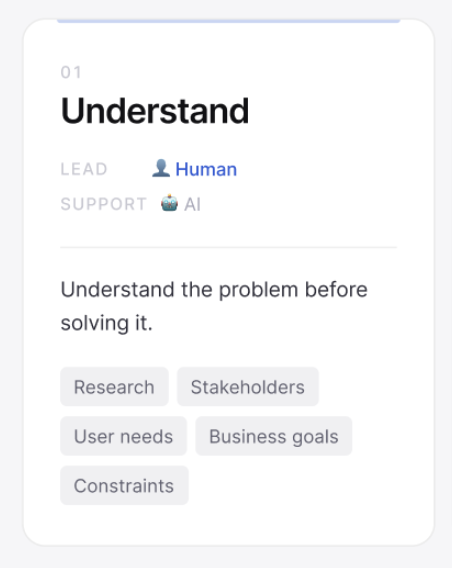
1. Understand
Lead: Human
Support: AI
Every project begins with understanding the problem.
That understanding comes from conversations with stakeholders, user research, business objectives
and technical constraints. It's built gradually as the team develops a shared understanding of what success looks like.
Generative AI is an excellent research assistant. I'll use it to summarise findings, identify themes, compare competitors and
organise large amounts of information.
But understanding isn't something AI creates.
It's something content designers develop through context, collaboration and experience.
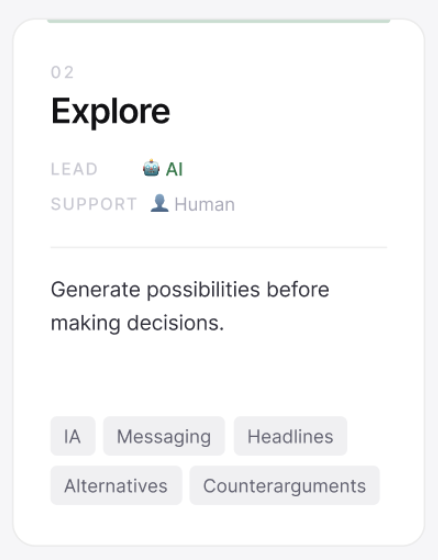
2. Explore
Lead: AI
Support: Human
Once the problem is understood, I deliberately widen the solution space.
This is where Generative AI is often at its strongest.
I'll use it to explore alternative information architectures, messaging territories, navigation models, interaction patterns and different ways of framing a problem.
The goal isn't to find the answer.
It's to discover possibilities I may never have considered on my own before narrowing the options through
human judgement.
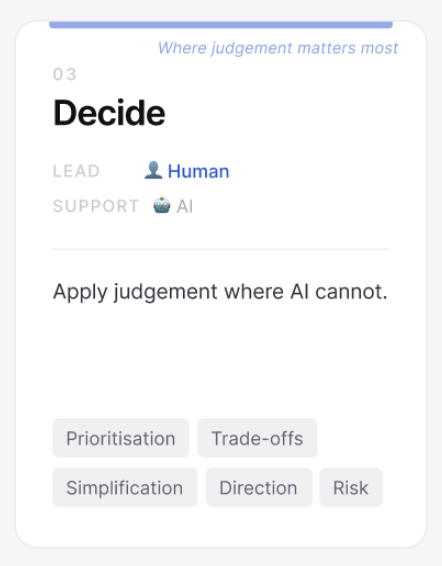
3. Decide
Lead: Human
Support: AI
This is the stage I believe defines experienced content designers. Every project eventually reaches a point where someone has to make decisions.
What matters most?
What should we remove?
Which compromise creates the best overall experience?
How do we balance user needs, business goals, engineering effort and legal constraints?
Generative AI can challenge assumptions, present counterarguments and pressure-test ideas.
But responsibility for the decision remains with people.
Judgement cannot be delegated. This is why I believe judgement remains the defining skill of experienced content designers.
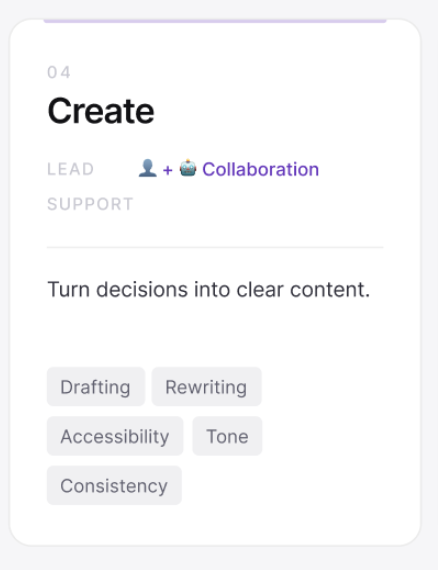
4. Create
Lead: Human + AI
Only now do I begin creating content. Ironically, this is the stage many people assume defines content design. In reality, it's where all the previous thinking becomes visible.
Generative AI becomes an outstanding production partner, helping draft content, improve clarity, simplify language, explore alternative wording and maintain consistency.
The productivity gains here are significant. But they're only valuable because the direction has already been established.
Without good judgement, AI simply helps us produce the wrong thing more efficiently.
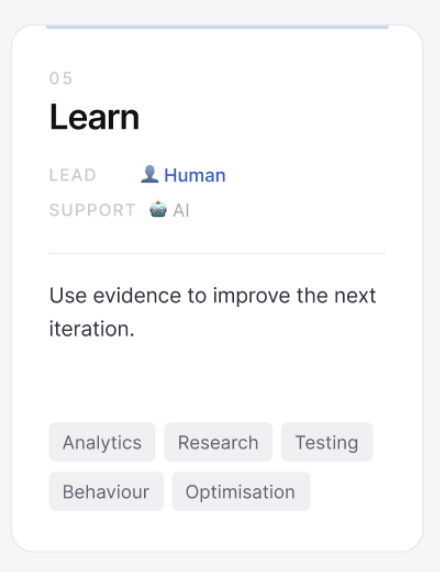
5. Learn
Lead: Human
Support: AI
Publishing content isn't the finish line. It's the beginning of the next iteration.
Research, behavioural analytics, usability testing and experimentation reveal whether people actually understood the experience.
Generative AI is excellent at identifying patterns across large volumes of feedback.
Content designers still need to interpret those patterns, decide what they mean and determine what should change next.
Learning is what strengthens every future iteration.
Some final thoughts
As Generative AI becomes more capable, I don't believe experienced content designers become less valuable.
I think our value becomes clearer.
The repetitive parts of our work will become easier. The invisible parts become more important.
Understanding problems. Building alignment. Making the trade-offs.
Exercising our judgement.
Those have always been the foundations of good content design.
Generative AI doesn't replace them. It gives us more time to focus on them.
That's why I don't see AI as replacing content designers.
I see it raising the value of the work we've always done beneath
the surface of that iceberg.